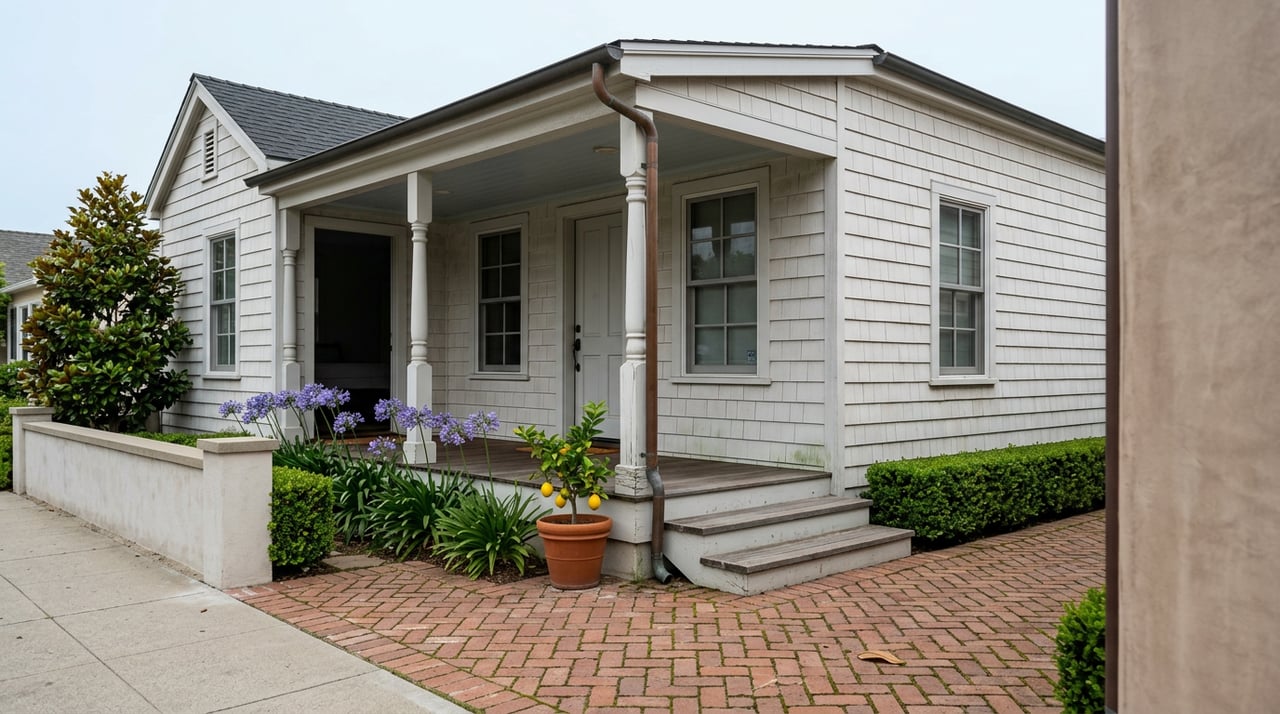
The listing price on a Newport Beach bayfront home in the summer of 2026 reflects a version of the property that is quietly ending. The water behind it, the dock permit tied to the parcel, and the annual rent the City collects for that permit are all being re-examined at once. Two homes on the same street, with the same façade and frontage, can differ by seven figures based on what sits in the water and what paperwork governs it.
That is the thesis of this piece. The visible number is the house. The number that is moving is the pier. If you are buying or selling on the bay this year, the pier is the story.
Start with the transfer, not the tour
Before the granite and the view, the transaction friction that catches people is the pier permit itself. A residential pier permit is issued to the owner of the abutting upland property for a term of up to ten years. It attaches to the person and the parcel, not to the dock as a standalone asset, and when the home sells the permit has to be formally transferred.
The mechanics run through the City of Newport Beach Public Works Department. A transfer application to the department requires buyer and seller signatures at close of escrow, a transfer fee, and a City pier inspection. That inspection is the friction. It surfaces bulkhead settling, missing cleats, undocumented modifications, and float condition issues that were invisible during the home inspection and are now the buyer's problem unless negotiated in advance. Who pays for those corrections is negotiable, and it is far easier to negotiate before you are past your inspection contingency, which is why the pier inspection belongs early in the timeline, not at the end.
Sellers who treat the pier as a bonus feature discover, days before closing, that it is a separate diligence track with its own City sign-off. Buyers who assume the dock conveys the way a garage does discover that it does not.
Why the annual pier rent is about to move
The reason 2026 matters more than a normal year is a state-level action that most buyers have not read. In December 2025, the California State Lands Commission issued a report on the City of Newport Beach's management of public trust lands, finding that the City is not charging fair market rent for residential piers sitting over City tidelands, and directing the City to commission a new independent appraisal of residential pier leases, reconsider how pier rental area is calculated including whether buffer areas and the interiors of U-shaped piers should count, review whether subleased residential piers should be billed at commercial rates, and end the practice of private mooring permit sales.
The Commission chair was blunt about the underlying finding. Lt. Gov. Eleni Kounalakis, who serves as commission chair, said "the rates being charged for the piers are too low" at the December meeting.
The City's own harbor page confirms the direction of travel. The City is conducting a new appraisal of its residential pier leases and will update rental rates, and the report identified a discrepancy in how the City calculates pier rental areas, excluding water areas where boats moor, versus the state's accepted methodology. The published timeline runs roughly as follows: new independent appraisals in 2026, a series of Harbor Commission public meetings through winter 2027 addressing transferability, appraisals, and phasing, a draft policy package in winter 2026 to 2027, and a comprehensive City Council vote in 2027, and no rate increases, transfer restrictions, or other policy changes take effect without Council approval and public notice.
Two things follow from that. First, nothing is final in 2026. Second, the range is not small. For comparison, the current mooring rate and the proposed license rate give a sense of scale on the water side. The current rate for offshore moorings is $3.34 per linear foot per month, meaning a 40-foot mooring costs about $133 each month, and under changes proposed by the City for an updated license program the cost would spike to about $15 per linear foot per month, or roughly $600 per month for a 40-foot mooring. Residential piers are governed under a different framework, but the direction of appraisal-driven rate resets is the pattern the buyer is stepping into.
The three lines that decide how much boat the home can hold
Bayfront frontage is not the number that matters. The distance from the seawall out into the harbor is.
Three surveyed lines determine how far into the water you can build and how big a vessel you can berth. They are not suggestions. The harbor lines in Lower Newport Bay were established by an act of the United States Congress and can only be modified by an act of Congress.
| Line | What it governs |
|---|---|
| Bulkhead | Where the deed generally stops and the pier permit begins |
| Pierhead | The seaward limit of the dock structure |
| U.S. Project Line | The federal navigation limit set by Congress |
The distance between the bulkhead and the pierhead line is, in blunt terms, how much boat the property can hold, and a parcel with 40 feet of that gap and one with 75 feet are not comparable assets, even with identical houses and identical frontage. When two homes on the same street price a million dollars apart, this is often the reason, and it is rarely obvious from a listing photo.
Dredging is the other buried cost. You typically own the dock structure but not the water or the land beneath it, and the dock sits on public tidelands under a City-issued pier permit tied to your ownership of the abutting upland property. The permittee, meaning the homeowner, pays for dredging between the side property lines extended bayward and the federal project line. Buyers who skip a bathymetric read on the slip are inheriting that math.
Where the rules bend: Beacon Bay, Balboa Bay Club, Harbor Island
Not every bayfront address sits on standard tidelands. State legislation has modified public trust restrictions for the historic tidelands at Beacon Bay, the Balboa Bay Club, and Harbor Island, and title in these areas can behave differently, which is exactly why a title review matters before you remove contingencies. A buyer comparing a Balboa Island cottage to a Beacon Bay leasehold is not comparing like assets. Both are called bayfront. One is a fee interest with a pier permit over public tidelands. The other is structured around a ground lease. Financing, resale, and long-term carrying cost diverge from there.
The Balboa Island premium is a scarcity premium
If you are drawn to Balboa Island specifically, the pier scarcity story shapes value in a way the median price hides. New noncommercial piers on Balboa Island are not approved unless the Harbor Commission finds the pier to be in the public interest, and an existing permitted pier is far more valuable than the prospect of adding one. Combine that with the island's structural geography, three modified or artificial islands, joined to the mainland by a two-lane bridge and served by a privately operated fleet of three, three-car ferryboats, and the pool of pier-equipped homes is not just finite. It is closed.
The market implication: on Balboa Island, the pier permit is not an amenity. It is the asset class. Two otherwise comparable island homes, one with a permitted pier and one without, do not just differ by the cost of building a dock. They differ by an option the buyer of the second home may never be granted.
What to order before you remove contingencies
For a bayfront transaction in 2026, the diligence list is longer than a standard resale.
- Preliminary title report with careful review of exceptions for tidelands, sovereign lands, leases, and easements
- Copy of the current pier permit and the most recent City pier inspection
- Confirmation of the bulkhead, pierhead, and U.S. project line distances for the specific parcel
- Written estimate of the current annual pier rent and any communicated re-appraisal schedule from the City
- If the property is Beacon Bay, Balboa Bay Club, or Harbor Island, the full lease document with rent schedule, renewal terms, and assignment rules
- Confirmation of whether the dock is subleased. Some pier permit holders sublease their docks without disclosing or paying fair market rent to the City, which the appraisal review is expected to address.
The next twelve months are a rare window where a buyer can price the pier as a known variable and a seller can position the pier as a documented one. After the 2027 Council vote, the numbers change. Homes that transacted cleanly through the transition will show it in the file.
FAQ
Does the pier permit transfer automatically at closing? No. It requires a formal transfer application to the City of Newport Beach Public Works Department, with buyer and seller signatures at close of escrow, a transfer fee, and a City pier inspection.
Are Newport Beach residential pier fees going up in 2026? Possibly. Following the December 2025 State Lands Commission report finding that the City is not charging fair market rent for residential piers, the City is conducting new appraisals and expects to bring a comprehensive policy package to the City Council in 2027. Nothing is final without a Council vote.
Can I build a new dock behind a Balboa Island home that doesn't have one? New noncommercial piers on Balboa Island are not approved unless the Harbor Commission finds the pier to be in the public interest, so assume an existing permitted pier is far more valuable than the prospect of adding one.
Can I make an existing dock bigger? Only within the pierhead line. Extending beyond it requires Harbor Commission approval and is the exception, not the rule.
Working the bay in this window
Bayfront homes are the most emotional purchase in Newport Beach and the most technical. The house is the easy part. The water, the permit, and the appraisal cycle behind them are where the value actually lives in 2026, and they reward buyers and sellers who treat them as first-order questions rather than last-minute ones. If you are considering a purchase or a sale on the bay this year, I would like to walk the specific parcel with you, review the permit and the harbor lines, and build a strategy around the window we are actually in. Ashley Marie with The Agency Corona Del Mar. Schedule a consultation.