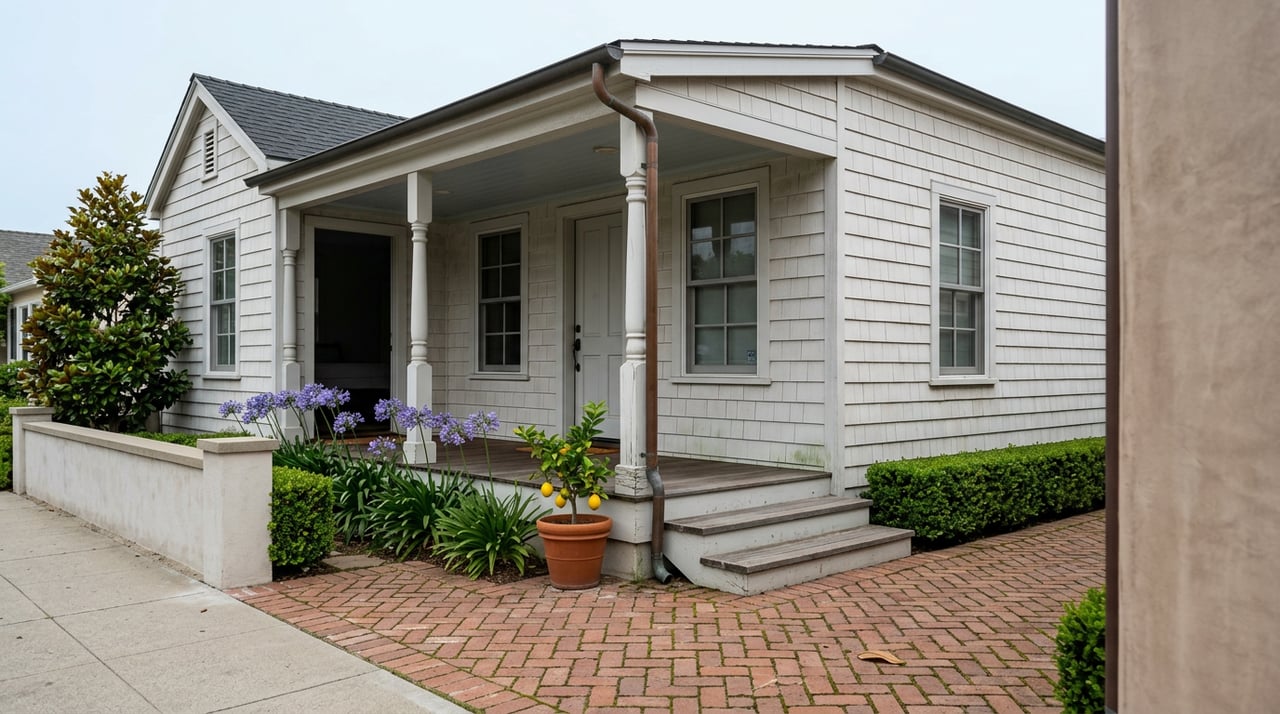
Walk two blocks on Goldenrod Avenue and you'll pass a 1930 cottage a buyer is renovating within its original footprint, and a lot next door where two similar cottages built in 1930 and 1936 are coming down to make way for three new front-and-back homes. Both properties will show up in the same comp set. Both will get filed under "Corona del Mar, single-family, Flower Streets." Neither is really the same product, and the difference between them isn't taste or timing. It's a line in the Newport Beach municipal code.
That's the thing buyers moving from a portal search to an actual offer keep missing here. Corona del Mar doesn't behave like one market with one median price. It behaves like three markets wearing the same zip code, and a specific city ordinance is what sorts a given lot into one bucket or another.
The rule that decides remodel or rebuild
Newport Beach's building code contains a threshold that quietly runs the entire redevelopment cycle in old Corona del Mar. Under Municipal Code Section 15.02.060, once the value of a remodel or addition permit exceeds 50 percent of the home's market value, the whole structure has to comply with current building code as if it were new construction. For a modest cottage on a small Flower Streets lot, that threshold is easy to cross with even a moderate renovation, which is exactly why the city calls out this rule as the reason so many owners decide a full teardown pencils out better than a partial remodel.
In 2022 the city tried to give owners another option. The voluntary cottage preservation program lets a qualifying owner add up to 50 percent of existing floor area or 750 square feet without triggering that full new-construction standard, as long as the new work stays inside a defined envelope: the front half of the lot capped at one story and 16 feet, the rear half at two stories and 24 feet, and no third floor or third-floor deck anywhere on the lot. It's a real path to keeping a cottage's scale while adding livable space. It also comes with a detail that surprises buyers who assume "preserved" means permanent: the city's own program description makes clear the deed restriction attached to a preserved cottage doesn't lock in preservation forever. A future owner can redevelop later under whatever standards are in effect at that time.
So the envelope is generous enough to save a cottage today, and honest enough to admit it isn't saving it forever.
What the cottage count actually shows
That code has been running against a shrinking supply for two decades. At their peak in the 1960s, an estimated 1,800 of these cottages lined the Flower Streets. Today fewer than 525 remain, and fewer than one in four lots in the village still has an original cottage sitting on it. A formal survey by the Corona del Mar Historical Society, launched in 2020, is the source of that tracking, and the pace hasn't slowed. It's accelerated.
The Goldenrod Avenue example is the pattern in miniature. Both cottages there predate the redevelopment wave by decades, built in 1930 and 1936 during one of the slowest construction stretches in Corona del Mar's history. They survived because there wasn't much competing new construction to replace them with. Now, on a block that connects directly to the Goldenrod Footbridge and the beach beyond, two lots are becoming three homes. That's not a story about one owner's preference. It's what the 50 percent threshold does to any cottage on a lot where new construction next door has already reset the comps.
Three products, one zip code
Here's the practical problem for a buyer comparing listings: a preserved cottage, a teardown lot, and a front-and-back duplex parcel can all show up within a few hundred thousand dollars of each other, and each one asks something different of you.
| Preserved Cottage | Teardown Lot | Front-and-Back Duplex Parcel | |
|---|---|---|---|
| What you're buying | An existing structure inside the cottage envelope, usually one story front, small second story over rear parking | Land value plus a structure the market has already priced to remove | Two individually parceled addresses on one original lot |
| Ownership structure | Standard single-family, deed restriction may apply | Standard single-family, no restriction if outside the program | No shared HOA, no management company, no reserve account between the two units |
| What limits future changes | The 16-foot front and 24-foot rear height caps, no third floor | Whatever the current zoning and coastal review process allows for new construction | Each address stands on its own permit and maintenance history |
| Typical buyer motivation | Wants the scale and charm now, understands it isn't guaranteed forever | Wants the location and plans to build to the current code from scratch | Wants a smaller footprint or investment structure without HOA overhead |
That last row matters more than it looks. Buyers who assume a Flower Street duplex functions like a condo, with an association handling exterior maintenance and a reserve fund covering the roof, find out at inspection that no such thing exists. Each half is its own legal parcel with its own obligations. That's a different risk conversation than the one you'd have on a preserved cottage or a raw teardown lot, and it's one that rarely comes up until an inspection contingency is already running.
Reading the market data with that lens
The bifurcation shows up in the transaction numbers too. As of mid-June 2026, homes that went under contract in under 15 days closed at an average of 100.2 percent of list price. Homes that took more than 30 days to find a buyer closed at an average of 94.0 percent. That six-point gap isn't really about pricing strategy in the traditional sense. It's what happens when a buyer pool understands exactly which of the three products they're looking at and moves fast, versus a buyer pool that's still trying to figure out whether the "charming cottage" photos are describing a preservation candidate or a placeholder on a teardown lot.
The same period showed 52 percent of recent Corona del Mar sales closing in cash, no financing involved. That's consistent with a market where a meaningful share of buyers are pricing land and redevelopment potential rather than qualifying for a mortgage against an existing structure's appraised value. And the spread at the top end makes the point almost by itself: while cottage-scale homes trade in the low millions, a bluff-front property on Ocean Boulevard was recently under contract at a $52 million asking price, a handful of blocks and an entirely different valuation logic away from the Flower Streets grid.
None of those numbers describe one market. They describe three markets that happen to share a mailing address.
Before you write an offer
If you're comparing a Corona del Mar listing against homes in other coastal Orange County neighborhoods, a few questions get you past the headline price faster than a generic comp pull:
- Ask whether the property currently carries a cottage preservation deed restriction, and if so, request the permit history that shows what's already been built within that envelope.
- Find out if the lot has been resubdivided from the original tract dimensions, since a widened parcel changes what future construction can look like.
- If the listing is a front-and-back duplex, confirm there's no shared HOA or reserve account, and get separate inspection scopes for each address.
- Ask your agent whether the block has seen recent teardown activity, since that resets the comp logic for every remaining cottage nearby.
- Treat the zip code's median price as a starting point for negotiation, not a ceiling or floor for your specific lot.
A charming exterior and a redevelopment-ready lot can sit three doors apart and cost about the same. Knowing which one you're bidding on is the entire skill.
FAQ
Does owning a cottage preservation property mean I can never expand it later? No. The city's own program materials note the deed restriction isn't indefinite. A future owner, or you at a later date, can redevelop under whatever building standards are current at that time. The restriction shapes what you can do now, not forever.
If I buy half of a front-and-back duplex, do I share costs with my neighbor? Not automatically. These are typically two separate legal addresses with no formal association, no shared management, and no reserve fund. Each side handles its own maintenance and permit history.
Is Corona del Mar's median price a fair comparison point against other Newport Beach or Huntington Beach neighborhoods? Use it carefully. A single zip-code median blends preserved cottages, teardown lots, front-and-back parcels, and bluff-front estates that can differ by tens of millions of dollars. Street-level and lot-type comparisons tell you far more than the headline number.
If you're weighing a Flower Streets cottage against a teardown lot, or trying to figure out what a Corona del Mar listing actually is before you write an offer, I'd rather walk the block with you than have you guess from photos. Reach out to Ashley Sells OC to schedule a consultation.