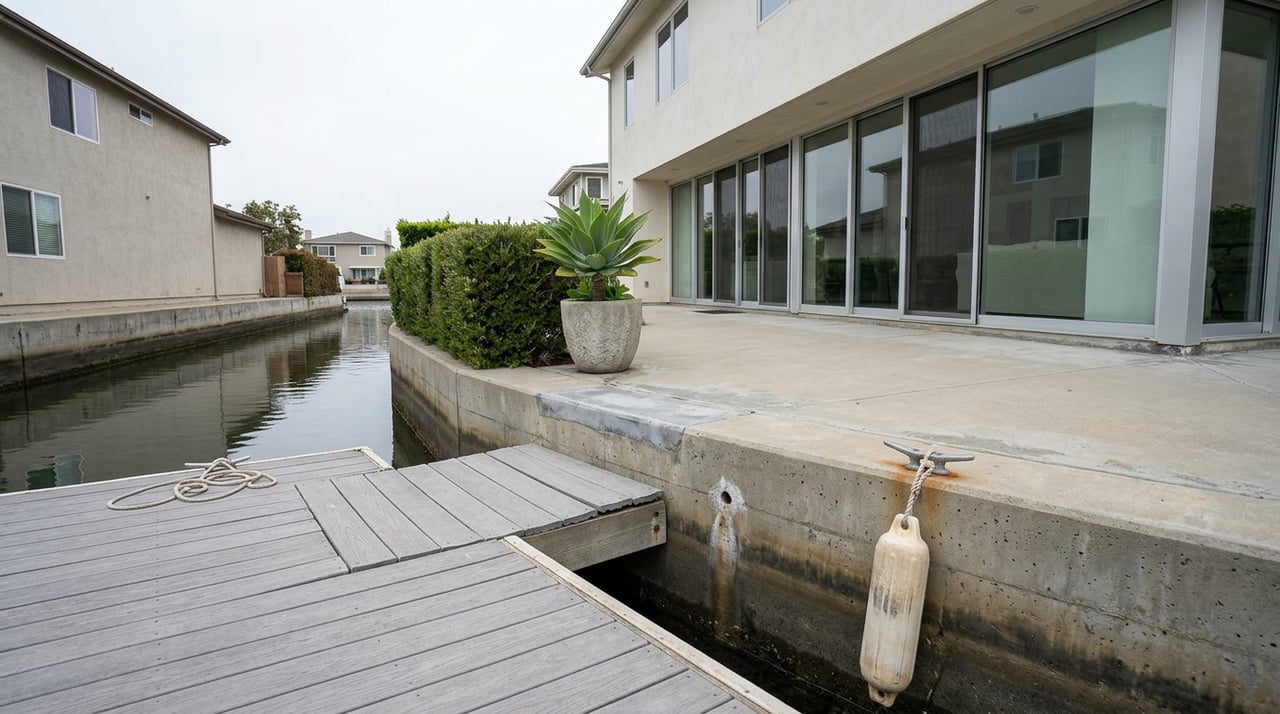
Every waterfront listing on Trinidad Island or Davenport Island photographs the same way: dock in the foreground, main channel behind it, maybe a Duffy tied off at the cleat. What the photo never shows is the file that comes with the property once escrow opens.
Most buyers treat the bulkhead the way they'd treat a fence or a pool deck: a fixed feature that transfers with the house, inspected once, disclosed once, done. In Huntington Harbour, that assumption is the friction point. The wall doesn't come with one rule. Its permit history is worth checking, whether or not anyone mentions it at the listing appointment.
The same wall, different permit histories
Huntington Harbour was dredged out of mudflats and built across its five islands in the 1960s, and the bulkheads that hold those islands together are reinforced cast-in-place concrete on untreated timber piles. Decades of tidal current, boat wake, and periodic channel dredging have worn on them unevenly, and properties fronting the main channel tend to show the most erosion, since that's where current and traffic concentrate.
CEQAnet's 2008 environmental review covered bulkhead repair across 30 individual single-family properties spanning Davenport Island, Trinidad Island, Gilbert Island, Humboldt Island, Edgewater Lane, and Morning Star Drive, treating each owner as independently responsible for the wall behind their own lot. But it isn't universal. The Log reported that the Westchester Bay Homeowners and Seagate Lagoon Associations went before the California Coastal Commission to seek a permit for structural bulkhead repairs.
A California Coastal Commission staff report describes a third category: sections of shoreline where the Commission itself retains permitting authority because the work falls seaward of the mean high tide line, regardless of who technically owns the concrete.
| What the record shows | What that looks like in practice |
|---|---|
| The individual homeowner | Documented in a 2008 filing covering 30 separate Harbour properties, each owner responsible for their own frontage |
| An HOA or lagoon association | Westchester Bay Homeowners and Seagate Lagoon Associations pursued a Coastal Development Permit together for shared bulkhead repair |
| The Coastal Commission's retained jurisdiction | Applies when the work sits seaward of the mean high tide line, pulling the project out of city review entirely |
The listing sheet won't tell you which column your address falls into. The permit history will.
Why the line in the water matters more than the line on the plat
Huntington Beach has had a certified Local Coastal Program since March 1985, which normally means the city, not the state, reviews coastal permits. But that delegation has a boundary. When a proposed project sits seaward of the mean high tide line, it falls back into the Commission's own retained jurisdiction, and the city's certified program becomes advisory guidance at best rather than the controlling standard.
That single locational fact, not the size of the dock or the age of the house, decides whether your bulkhead question gets answered by city planning staff or by Coastal Commission staff in a public hearing. A 2019 permit for cantilevered decks in Huntington Harbour's Open Space Water Recreation zone landed squarely in that retained jurisdiction because of exactly this line, even though the city's own program covered the residential parcel just a few feet inland.
What the last owner agreed to still binds you
Coastal Development Permits don't expire when the house sells. They run with the land, and the conditions attached to them are written to bind, in the Commission's own language, all future owners and successors.
That matters most when a permit contains a no-encroachment condition. A 2025 California Coastal Commission staff report describes a permit for deck work at a Devon Circle property in Huntington Harbour that required a Bulkhead Condition Report from a coastal engineering firm before approval and imposed a permanent condition: no future repair, reinforcement, or maintenance of that bulkhead can extend bayward of its current footprint, and the property owner waives that right for every owner who comes after them. If the wall someday needs real structural work, whoever owns the house at that point is already locked into rebuilding it in the exact same footprint, no matter what a marine engineer might otherwise recommend.
Older permits show a second layer worth knowing before you write an offer: the monitoring schedule itself isn't standardized. One set of Coastal Commission conditions from 2007 required a licensed engineer to inspect the bulkhead reinforcement every two years for the first twelve years, then annually after that. A later revision for a different Harbour permit relaxed that standard, allowing the initial inspections to be done by anyone familiar with bulkhead structures who could document conditions through photos, reserving the licensed engineer for when actual deterioration showed up.
Translation for a buyer: two houses on the same island can carry two different legal maintenance obligations, negotiated in two different years, for two structurally similar walls. You inherit whichever one is on file for your address.
What to actually request before contingencies expire
For a standard inland home, a general inspection covers most of what a buyer needs. On Harbour waterfront, that inspection is the start of the list, not the end of it. Local inspectors who work canal and Harbour lots already scope bulkhead and seawall condition, dock and pier framing, fasteners, and the tidal water table separately from the rest of the home, because salt air and constant tidal exposure wear those systems on a different timeline than anything inland.
Before removing contingencies on a Huntington Harbour dock home, ask the seller or their agent for:
- Any Coastal Development Permit on file for the bulkhead, dock, or seawall, including the special conditions attached to it
- The most recent Bulkhead Condition Report, if one exists, and the name of the firm that prepared it
- Documentation of who has historically paid for bulkhead maintenance on that parcel: the owner directly, an HOA, or a lagoon association
- Whether any no-encroachment or similar permanent restriction is recorded against the bulkhead's footprint
- HOA governing documents and reserve study, if the property sits within an association, since bulkhead repair reserves are typically buried in the same fund as pool and clubhouse maintenance
A qualified marine or dock inspector and a real estate attorney familiar with coastal permitting can pull most of this before your inspection period closes. It's substantially cheaper to ask these questions in escrow than to discover the answer during a Commission hearing five years into ownership.
Where the paper trail meets the public process
Huntington Beach's Harbour Commission, seven citizen appointees who meet the fourth Thursday of each month at the Civic Center on Main Street, exists specifically to advise the City Council on harbor infrastructure, seawalls, pier head lines, and water quality. Its meetings are open, and its recommendations are often the first public signal of a policy shift that eventually shows up in future permit conditions. For anyone who already owns on the water, or who's about to, it's a useful place to see how the rules are evolving before they land in a staff report with your address on it.
A few questions worth asking directly
Does every Huntington Harbour home need a Coastal Development Permit to touch the bulkhead? Not always. Huntington Beach's coastal code includes categorical exclusions for certain minor work in defined areas, but substantial repair, replacement, or anything seaward of the mean high tide line typically triggers full review.
Can a buyer request the permit history before making an offer? Yes. Coastal Development Permits are public record through the California Coastal Commission, and prior city permits are available through Huntington Beach planning records. Both are worth pulling before you're deep into an inspection period.
Does a well-maintained bulkhead mean there's no restriction on file? Not necessarily. A wall can be in excellent condition and still carry a permanent no-encroachment or monitoring condition from a permit issued years ago. Condition and legal history are two separate questions, and both deserve an answer.
If you're weighing a waterfront purchase in Huntington Harbour or preparing to list one, the permit file is worth pulling before the sign goes in the yard. Ashley Marie works this stretch of coastline directly and can help you get the right questions in front of the right documents before contingencies expire. Schedule a consultation to start there.
This article is general information, not legal, tax or financial advice. Consult a qualified professional about your situation.